
Why Concrete Cracks in North Texas: It Starts Under the Slab
Most concrete cracks start below the slab, not in it. How sub-base prep, compaction, and drainage decide how long your concrete lasts in North Texas.
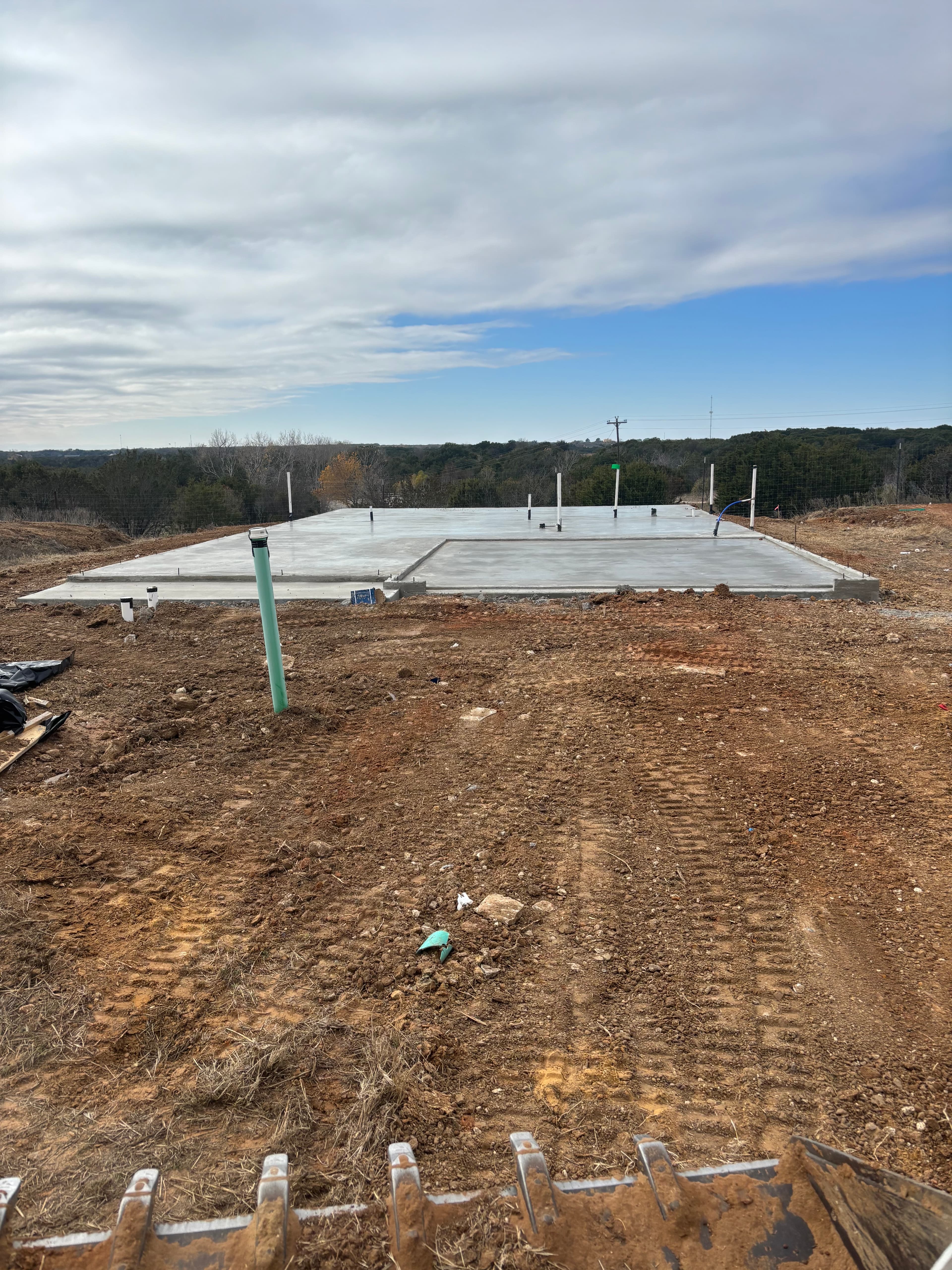
When people picture a new concrete project — a driveway, a patio, a commercial slab — they picture the surface. The smooth gray finish, the clean edges, the way it ties the property together.
But how long that surface lasts has very little to do with what you can see. It's decided by what's underneath: the sub-base. Skipped or rushed site prep is the number one silent killer of concrete, and by the time it shows up as a crack, the mistake is already years old and buried under the slab.
Here's what's actually happening under your concrete, and what proper prep looks like.
Concrete Is Strong in the Wrong Direction
A common assumption is that a thick slab can bridge over soft or uneven ground through sheer strength. It can't. Concrete is extremely strong in compression — you can stack enormous weight on it — but weak in tension. When it bends, it breaks.
If the ground underneath settles unevenly, voids open up beneath the slab. Now part of the slab is supported and part of it is hanging. Drive a truck over that unsupported section and the slab flexes — and flexing concrete becomes cracked concrete. No amount of thickness fixes support that isn't there.
North Texas Clay Works Against You
Around here, the soil itself is the main opponent. Most of our service area sits on expansive clay: it swells when it's soaked and shrinks and pulls away during long dry stretches. A slab poured directly on that soil rides an elevator that moves a little every season.
That shrink-swell cycle is the same reason driveway lifespan varies so much in this region. A properly built sub-base — compacted crushed aggregate over stabilized soil — acts as a transition layer. It spreads loads evenly, cushions the slab against soil movement, and keeps seasonal moisture swings from translating directly into stress on the concrete.
Water Is the Other Enemy
Water that pools against a slab or behind a retaining wall does two kinds of damage. It builds hydrostatic pressure that pushes on the structure, and it washes the fine material out from under the base — creating exactly the voids that cause cracking.
That's why sub-base prep and drainage are the same conversation. The subgrade has to be sloped so water moves away from the concrete, not under it. Get the grading right and the base stays dry and solid for decades. Get it wrong and the best pour in the world is living on borrowed time.
What Proper Prep Actually Looks Like
When we prep a site, the pour is the last step, not the first. Before any concrete arrives:
- Excavate to stable material — remove topsoil, roots, and anything organic that will decompose and settle
- Grade and slope the subgrade so water drains away from the slab
- Compact the soil so it can't settle later under load
- Place crushed aggregate base and compact it — uniform, solid support across the entire footprint
- Set forms and reinforcement to spec, and plan control joints before the truck shows up
None of this is visible in the finished product. All of it is why one driveway lasts 30 years and the identical-looking one next door cracks in five.
Summer Raises the Stakes
We're writing this in July for a reason. In Texas summer heat, fresh concrete can lose surface moisture faster than it cures, which invites shrinkage cracking on top of any support problems below. That's why summer pours start early in the morning, before the heat peaks, and why the summer mix is adjusted to slow the cure. A dry, stable, well-drained base is part of that equation too — prep and weather work together, or against you.
Our Standard for Site Prep
Every project we pour — driveways, foundations, flatwork, walls — gets full sub-grade compaction, an engineered base, and grading that moves water away from the concrete. It's slower and it costs more than pouring on dirt. It's also the difference between concrete that lasts and concrete that has to be torn out.
Planning a concrete project, or want a second opinion on a bid that seems too cheap? The prep is usually where cheap bids cut.
Frequently Asked Questions
- Why is my new concrete already cracking?
- Hairline surface cracks are normal as concrete cures and shrinks. Wide cracks, heaving, or sections that sink within the first few years usually mean the problem is under the slab — soil that wasn't compacted, a missing gravel base, or water getting underneath. Those cracks are structural, not cosmetic.
- What is a sub-base and why does concrete need one?
- A sub-base is a layer of compacted crushed aggregate between the soil and the slab. It spreads loads evenly, gives the concrete uniform support, and acts as a buffer over North Texas clay, which swells when wet and shrinks when dry. Concrete cracks when its support moves — the sub-base is what keeps the support from moving.
- Can concrete be poured directly on dirt?
- It can, and on cheap bids it often is. In North Texas clay, pouring directly on unprepared soil is one of the most common reasons a slab cracks or heaves within a few years. The soil under the slab has to be compacted and stable, and in most cases topped with compacted aggregate, before any concrete goes down.
- Does hot weather make concrete more likely to crack?
- Yes. In summer heat, the surface of fresh concrete can dry out faster than the concrete underneath cures, which causes shrinkage cracking. That's why summer pours are scheduled for early morning and the mix is adjusted to slow the cure. Good sub-base moisture control matters even more in the heat.