
Is Your Foundation Moving? Fall Signs to Check in North Texas
Sticking doors and new cracks after a North Texas summer: which are seasonal, which mean the slab moved, who to call for each, and how a slab is built for clay.
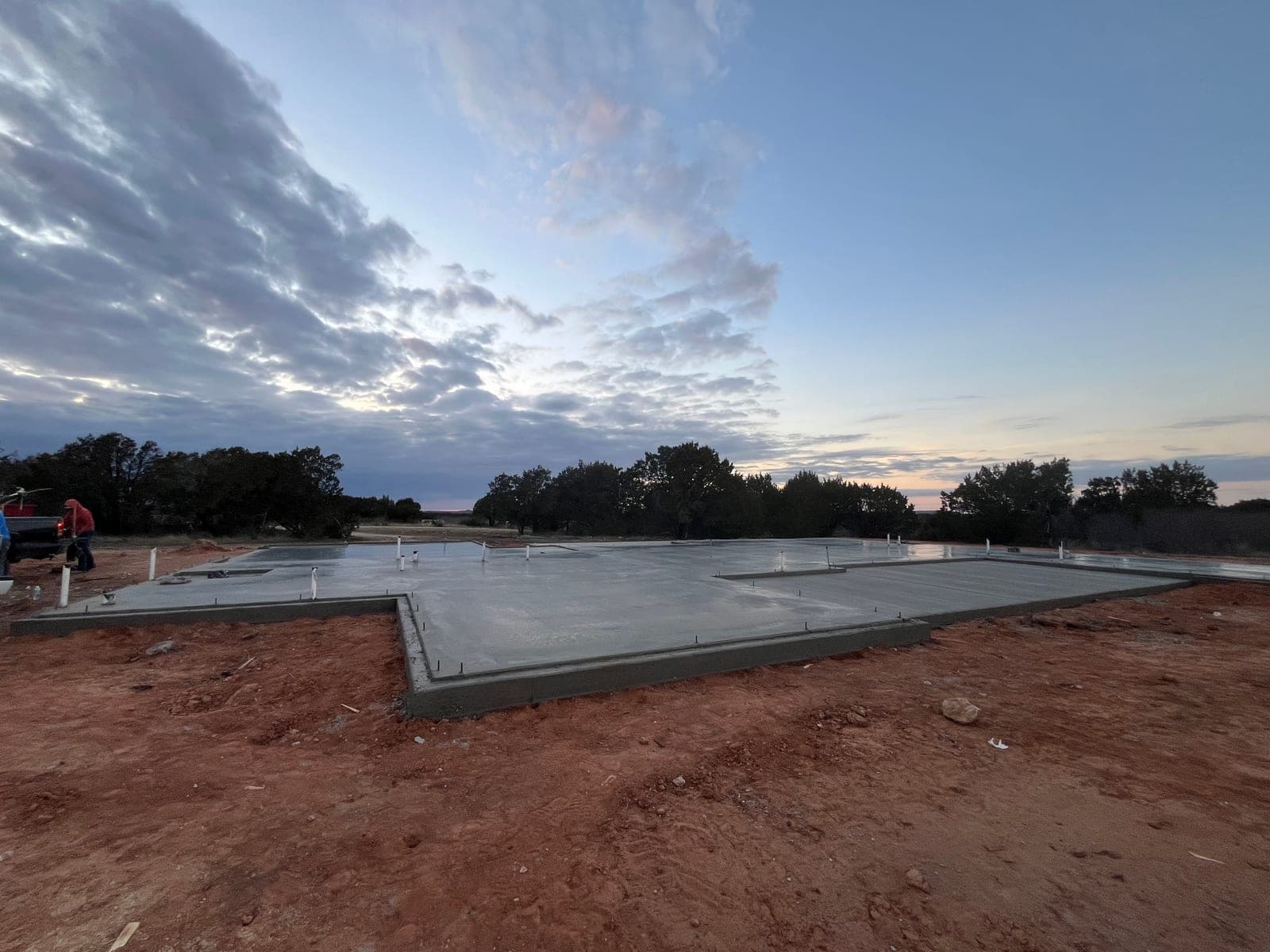
By October the summer has done its work on the ground under your house. Three months of drought shrank the clay, and the fall rain is about to swell it back. That push and pull is why so many people west of Fort Worth notice a sticking door or a new crack right about now.
Most of what you'll find is seasonal. Some of it isn't. Here's how to tell the difference, who to call for each, and what a slab that was built for this clay looks like.
What a Texas summer does under a slab
The soil across Parker, Palo Pinto, Hood, and Erath counties is heavy with expansive clay. The slab in the photo above was poured in Poolville, in Parker County, on exactly that ground: red clay, the black gumbo that can swell by 30 to 40 percent in volume when it's saturated and shrink by about as much when it dries. The heat itself isn't the problem. The drought is.
In a dry summer the clay under the edges of a slab dries out faster than the clay under the middle, because the edges are exposed to sun and air. The soil pulls away, the perimeter loses support, and the slab flexes. Then October brings the first real rain of the fall, close to four inches on average in Mineral Wells, and the same soil swells and pushes back. A slab that was poured without deep edge beams, proper reinforcement, or a compacted sub-base shows that movement first.
Walk the house: four things to check this month
You don't need an engineer to do the first pass. Take fifteen minutes and look for these.
Doors and windows. Interior doors that rub the frame, or windows that got hard to open over the summer. If it started in July and eases when the rain comes, that's the clay. If it started in the last few months and keeps getting worse, note it.
Drywall cracks. Hairline cracks that don't change are normal in any house. Diagonal cracks running from the corners of doors and windows are the ones to watch, and a quarter inch wide is the point where engineers say get it looked at.
Brick and mortar. Walk the outside. Stair-step cracks following the mortar joints, or a gap opening between the brick and a window frame, mean the slab under that wall has moved.
Floors and the flatwork around the house. Inside, gaps between the baseboard and the floor, or tile that cracked with nothing dropped on it. Outside, a patio, porch, or walkway that has dropped away from the house, or a driveway section sitting lower than its neighbor. That outside concrete is usually the first thing to settle, because it's thinner and sits on shallower ground than the house slab.
Whatever you find, mark it. A pencil line at each end of a crack with the date tells you in three months whether it's moving. Change over three to six months is what matters, not the crack itself.
Who to call, and for what
This is the part most contractor blogs skip, so here it is plainly.
If the house slab is moving, start with a structural engineer, not a foundation repair company. An engineer's evaluation costs a few hundred dollars and comes with no product to sell. A free inspection from a repair company is a sales call, and in a county full of clay you'll get a repair quote whether you need one or not. We don't do structural repair on existing house foundations, and when someone calls us with stair-step cracks in their brick, an engineer is who we send them to.
If it's the concrete around the house that dropped, that's flatwork, and that's us. A sunken patio or porch, a walkway that pulled away from the slab, a driveway section that tilted: those get the ground fixed and the section re-poured on a compacted base, which is cheaper than people expect and takes a day or two.
If a slab is past saving, we replace it, from a walkway all the way up to the foundation under the house. And if you're building new, that's us too: shops, barns, additions, and house foundations, built for this soil from the ground up.
What a slab built for this clay looks like
A foundation doesn't resist clay by being thick. It resists it by being designed for movement.
- Deep edge beams. The perimeter is where the soil dries first, so the edge of the slab goes down into the ground as a thickened beam instead of sitting flat on top of it. A standard residential slab here is 4 inches with thickened edge beams, 5 to 6 inches where a garage or shop puts real load on it.
- Reinforcement placed per plan. Rebar or post-tension cables, laid out before the pour, not dropped in as an afterthought. Steel is what holds the slab together when the ground under it moves.
- The right mix, placed at the right slump. We work with ready-mix suppliers who know North Texas soil and weather. The mix design is the difference between a 20-year slab and a 50-year one.
- Curing, which almost everyone skips. Curing compound right after the finish, and wet-curing in extreme heat, so the surface doesn't dry faster than the slab underneath. Seven days before framing, 28 days to full strength.
- Drainage designed in. Where the water goes when it leaves the roof decides how evenly the soil around the slab stays wet. Downspouts should carry water four to six feet from the foundation, and the yard should fall at least six inches over the first ten feet.
Slab-on-grade is what most new construction out here uses. On a sloped lot, or an older home, pier and beam can be the right answer instead, and that's a conversation worth having before anything is quoted.
Why October is the month to look
Two reasons. The clay is at its driest right now, so anything that's going to show has shown. And the fall rain, the first freeze around November 15 in Mineral Wells and November 22 in Fort Worth, and a wet winter are all about to work on whatever you found. A crack that fills with water and freezes is a bigger crack by spring, which is the same reason we wrote about sealing patios before winter last month.
October is also the easiest month to pour. Mild days and cool nights let a new slab cure evenly, and a flatwork re-pour scheduled now is done before the holidays instead of waiting on spring.
The short version
- Doors that stick in late summer and ease in fall: seasonal, watch it.
- Diagonal cracks from door and window corners at a quarter inch, stair-step cracks in brick, cracks with one side higher than the other, or anything that changed in the last few months: call a structural engineer.
- Patio, porch, walkway, or driveway that dropped: call us.
- Building new or replacing a slab: call us, and ask about edge beams, reinforcement, and curing before you compare prices.
From Weatherford and Granbury to Mineral Wells and Stephenville, we'll walk the property with you and tell you which of those it is.
Frequently Asked Questions
- Are foundation cracks normal in Texas?
- Some are. Hairline cracks in a slab, and thin cracks in drywall or mortar that stay the same size, come from normal shrinkage and the clay under the house moving with the seasons. What's not normal is change: a crack that widens, one side sitting higher than the other, or a diagonal crack from a door or window corner that reaches a quarter inch wide. Those mean the slab is moving unevenly.
- Why do my doors stick in the summer and fall in Texas?
- Because the clay under the slab shrinks in a dry summer and the framing above it goes slightly out of square. A door that was fine in spring and rubs a little by September, then eases up when the rain comes back, is seasonal. A door that stopped latching in the last few months and keeps getting worse is a different thing and worth an evaluation.
- When should I worry about a crack in my foundation?
- When it changes. Mark the ends of the crack with a pencil and date it. If it grows, if the two sides go out of plane, or if a stair-step crack opens in the brick, call a structural engineer for an evaluation. An engineer has nothing to sell you; a free inspection from a repair company is a sales call.
- Should I water my foundation in North Texas?
- During a dry stretch, yes. The goal is to keep the soil around the slab from swinging between bone dry and soaked. A soaker hose run around the perimeter on a schedule in the dry months does it. If you can see a gap between the dirt and the slab edge, the soil has already pulled away, and that is the cue to water, not to fill the gap with sand.
- Does Pillars Concrete repair foundations?
- No. Our work is new foundations and slab replacement, from flatwork all the way up to the foundation under a house, plus the patios, porches, walkways, and driveways that settle around it. For structural repair on an existing house foundation we'll point you to a specialist, and we'd suggest an engineer's evaluation before anyone quotes you a repair.